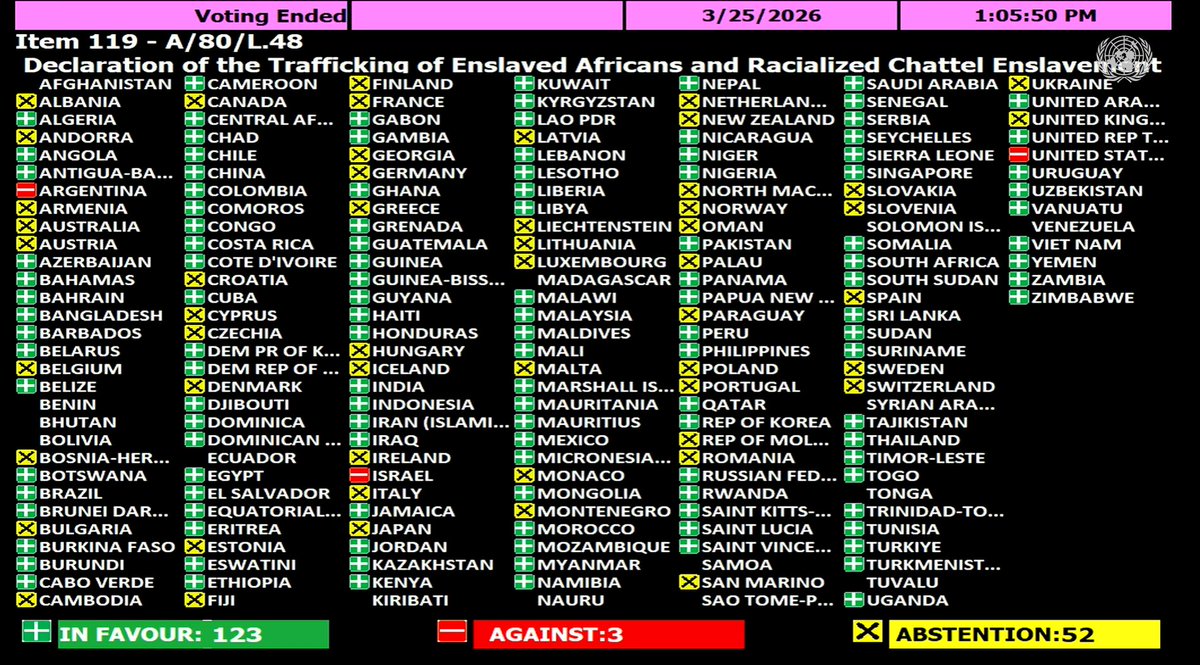
With this vote, the international community has taken a further step towards recognising the historical violence associated with slavery – globally in general, and concerning Africans in particular.
For more than four centuries, millions of African men, women and children were torn from their homeland, deported and exploited as part of a global economic system based on their dehumanisation. The repercussions from these events are not confined to the past, as they continue to shape and influence contemporary social, economic and racial inequalities.
Although this resolution is not legally binding, it nonetheless expresses both a duty to remember and a desire for justice. It encourages countries to take concrete steps: official recognition, remembrance, restitution and even reparations.
However, this text did not meet with unanimous approval. The United States justified its opposition by arguing that describing the transatlantic slave trade as “the gravest crime against humanity” risked establishing a hierarchy among historical atrocities, to the detriment of other crimes recognised under international law, such as genocide or war crimes. Washington also expressed concerns regarding the potential legal implications of this wording, particularly with regard to reparations.
For their part, several European countries who abstained shared some of these reservations. Whilst they fully recognise the historical and moral gravity of slavery, they emphasised the need to maintain a universal and non-hierarchical approach to crimes against humanity. Some also highlighted the complexity of issues of historical responsibility and the risks of legal or political disputes that such a classification might give rise to.
These differences reflect the persistent tensions surrounding issues of remembrance and the legacies of the colonial past. However, they do not prevent scientific, educational and public awareness work on the history of the slave trade and slavery from continuing.
Domaine Panon-Desbassyns
Saint-Gilles-Les-Hauts
Tel. : 0262 55 64 10
Email: musee.villele@cg974.fr
Get there
Open from Tuesdays to Sundays 9.30am to 12.30pm and 1.30pm to 5.30pm
Closed on Mondays
Closed 1st May / 1st January / 25th December
Scientific committee
Legal notice