An article written by the historian Jean-François Géraud.
Joseph Desbassayns was the eighth child and seventh son of Henri Paulin Panon Desbassayns (1732–1800) and Marie-Anne Thérèse Ombline Gonneau-Montbrun (1755–1846).
It is not easy to recount the history of a man who achieved no historical notoriety during his lifetime and who was also the son of a central and fascinating figure in the history and mythology of Reunion: Madame Desbassayns. His mother, who has more or less justifiably attracted the attention of historians, thereby deprived her children of any visibility. Yet she was merely a wealthy landowner living the traditional life of the late 18th century, neither particularly bold nor innovative.
At first glance, her son Joseph was simply a planter, one inhabitant among others on the island of Bourbon (now Réunion), and like his brother Charles, perhaps even more so, he has fallen into oblivion. No memorial site, no street, not even a cul-de-sac, nor any feature of Reunion’s rugged landscape bears his name today.
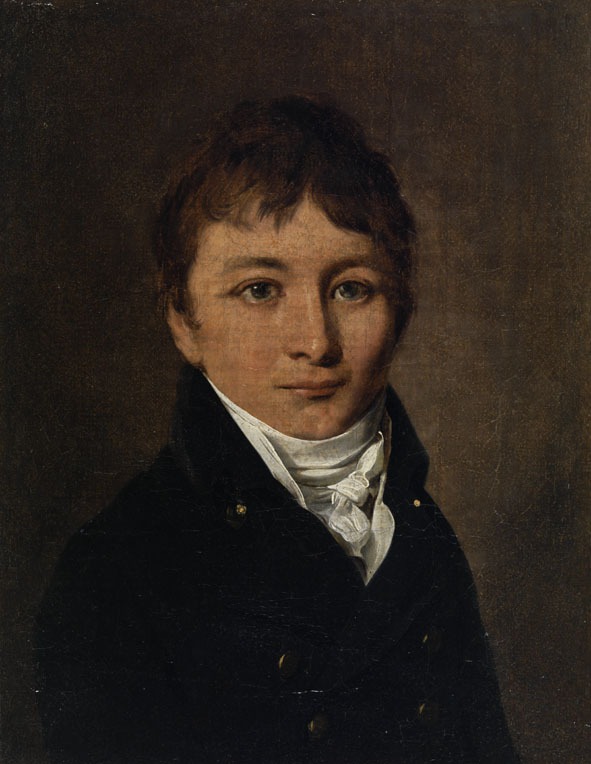
[Between 1790 and 1800]. Oil on canvas.
Collection of Léon Dierx art gallery, inv. 1911.08.01
And yet Joseph was a determined, and likely unhappy, architect of modernization and modernity on the island of Reunion. At the very beginning of the 19th century, he belonged to that enterprising and bold generation that pulled the island out of the stagnant routine of a declining coffee crop and a clove trade struggling to find buyers, and connected it to the sugar-cane crop and sugar production: what I call the ‘sugar transformation’ of the island.
His life as a sugar producer began with the development of a method for growing sugarcane that spread throughout Reunion, across the Indian Ocean, and into the French colonies, and was still being recommended at the end of the 19th century. This method was characterized by crop rotation, the codification of planting cane in trenches, and the regulation of its maintenance and harvesting. Above all, it was remarkable for standardizing both the tools and the gestures of enslaved workers: the tools were given precise dimensions, movements were measured to the millimetre, and Black labourers were thus transformed almost into mechanical beings, in fields that resembled factories: an anticipation of American Taylorism.
Blinded by his passion for progress and production, however, the planter ultimately fell into ruin through the importation of (British) machinery and the purchase of properties whose returns never managed to offset the cost of their acquisition. From the 1830s onward, Joseph Desbassayns was forced into a long process of liquidating all his assets.
The sugar producer was also a sick man. He suffered from a condition known at the time as ‘les barbiers’, which gradually deprived him of the use of his legs. By 1820, barely forty years old and unable to walk, he had to be carried everywhere in a chair borne by sturdy Bambara men. Testing every folk remedy at his disposal, he believed he had found salvation in Mesmerism, or animal magnetism: a fashionable quack practice existing in the late 18th and early 19thcenturies.
Politically, he was a conservative animated by an outdated loyalty to the white flag and the Bourbons. Settled in Paris in 1845, he accompanied King Louis-Philippe, driven from the throne by the 1848 Revolution, into exile in England. Socially, Joseph supported the maintenance of slavery, which he believed he could render acceptable by establishing a model prison on his estate, posting edifying religious engravings on the walls of the hospital that housed his sick slaves, and promoting the evangelization of the Black people under his authority.
He died in Paris, where he had returned, on April 17th 1850, and was buried in Père Lachaise Cemetery. Today, he perfectly illustrates the ambivalence of the history of Reunion, torn between retrograde loyalties hardened by distance and a fierce desire for modernity, with frequently undefined objectives and consequences that were often contradictory and fraught.