Perrine Elisabeth’s situation is not an isolated one. She was registered in the Republic’s brand-new civil registers on 13th January 1794, a few months after her birth on 28th November 1793. She was the illegitimate daughter of Citizen Fille, who herself came from two generations of enfranchised people, some of whom traced their origins to Madagascar.
Reconstructing a life from fragmented archives means recreating identities from scattered traces; it means attempting to breathe new life into marginalised existences, based on a single date or a few terse lines. It also means coming to terms with what the documents leave unsaid or the silences within them, in an attempt to restore Elisabeth’s place in the history books via her own brief chapter.
We owe a debt of gratitude to the community of amateur genealogists who have compiled and then made available online vast collections of civil registry records from Réunion, usually with references to their sources – a guarantee of authenticity for historians.
Perrine Elisabeth (the first name Augustine was added in some civil status records) was the eldest of her siblings, all born free, but without a surname; her mother, Fille (or Fine in some records), was a slave before being enfranchised. Fille could have registered her mother’s name ‘Montauban’ with the civil registry, as Geneviève Javotte, her mother, born in 1742, was enfranchised in 1783 by Monsieur Joseph Deguigné de Labérangerie. The latter was herself the daughter of two Malagasy slaves, Charles and Geneviève, who arrived on the island in 1720 and were freed by the same Deguigné.
Upon the birth of her first son on 21st February 1765, Geneviève Javotte declared “Jean Baptiste Deguigné, son of Labérangerie, to be the child’s father”. On 22nd September 1788, she enfranchised her children, including her daughter Fille: “paid for with the proceeds of her savings, aided by Mr Deguigné de Monrepos, from whom she obtained her freedom”.
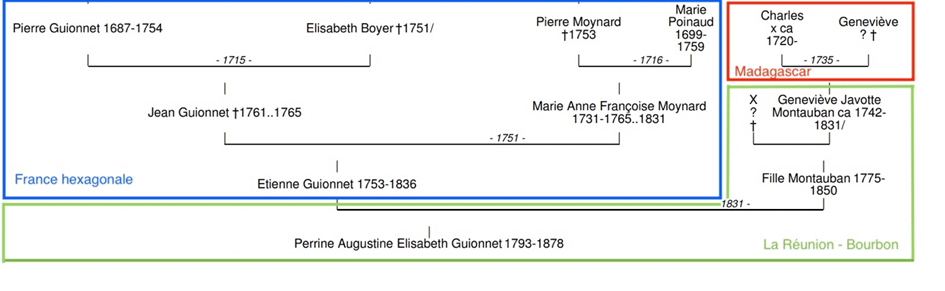
Sabine Noël later highlights in Amours et familles interdites the ‘power of time and love’ shown by Elisabeth’s parents (Etienne Guionnet and Fine (Fille) Montauban) this white man, a merchant and blind landowner, bequeathed his entire estate to his free, coloured wife; by 1831, he was living with her. It was their son Victor Guionnet, who had become a tax clerk, who completed the census form, signing it in his official capacity but also on behalf of his mother, the person making the declaration.
Elisabeth is sometimes identified in civil registry records without a surname and sometimes under her mother’s surname ‘Montauban’ until the birth of her daughter Arthémise Adrienne in 1833. Her father officially recognised her (along with six other siblings) at the time of his marriage to her mother on 9th July 1831. From that date, she used the surname Guionnet. Raoul acquired her surname much later, at the age of 67, upon her marriage on 23rd October 1861, six days before the death of her husband, Louis Pierre Gustave Raoul. The name Montauban is the one by which she was known in society, whilst at the same time serving as a lasting reminder of her coloured origins, which became the hallmark of a different identity imposed upon her: the deed of sale in 1849 (even though she had borne the name Guionnet since 1831) specifies that ‘Mademoiselle Perrine Augustine Elisabeth Guionnet is henceforth known as Montauban’. Later (and perhaps to correct this?), when her daughter Marie Élise Sabine married Monsieur Antoine Louis Perticoz in 1856, she took care to add the surname ‘Montauban’ to ‘Raoul’.
The act of bearing a name reveals the full complexity of colonial society. It can exclude, accept, or even elevate the person who bears it.
A systematic examination of civil registry records, censuses and mortgage deeds brings Elisabeth’s story to life.
There is little evidence of her education, which was no doubt basic and practical, judging by the various occupations recorded: she was, in turn, a trader, a shopkeeper, a seamstress, but also a landowner.
There are no records shedding light on the context of her meeting Gustave Raoul. On his father’s side, he was descended from two generations of officers who had settled in Mauritius and then on Bourbon Island / Réunion. Claude François Raoulx, his grandfather, originally from Besançon, settled on Île de France in the mid-eighteenth century and is recorded as a captain in the island’s national militias. His father, Louis Raoul, distinguished himself as a second lieutenant alongside Suffren in the naval battles of Nagapatam, Trinquemalé and Gondelour. Having risen to the rank of lieutenant, then commander, and having been made a Knight of the Order of Saint Louis and subsequently of the Legion of Honour, he settled in Saint-Denis, where in 1794 he married Félicité Hortense, the daughter of the paymaster Pierre Rathier-Duvergé; the wedding was celebrated in the presence of Governor Jean-Baptiste Vigoureux Duplessis in 1794. They divorced on grounds of irreconcilable differences in 1804.
Until the 1824 census, Gustave lived with his brother Thomy at their father’s home, an elegant bourgeois residence in Saint-Denis, on Rue de l’Intendance. Their sisters Estelle and Phisocé were married to the brothers Benjamin and Prosper Gourel de Saint-Perne, who, together with Louis Raoul, ran a thriving boat business.
It is clear that Gustave’s relationship with Elisabeth, in such a context, must have been frowned upon by society. Reading between the lines of the civil registry records is particularly revealing. Until 1826, no mention of the father appears in the birth records. In 1826, Louis Raoul was in Mauritius; his son’s partner, Elisabeth Montauban, registered the birth of a daughter, Lodoïska, ‘at her home, the Raoul house’. This location is specifically named in several documents: a vast plot of land behind the King’s Garden. Louis Raoul died the following year, with a grand funeral held in Port Louis, Mauritius: ‘a guard of 50 soldiers under the command of Major Hervey accompanied the funeral procession to the church. In the front row of the mourners was General Keating, who [sic] had fought against one of the companies led by Raoul when they marched on Saint-Denis on 8 July 1810’… In 1828, Gustave Raoul appeared for the first time at the town hall to register a boy “whom he named Alexandre Desablons” and specified on that occasion that Mrs Montauban “gave birth at his home […] in his house behind the King’s Garden”. The establishment of this child’s paternity is clear, even if it is not formally recorded.
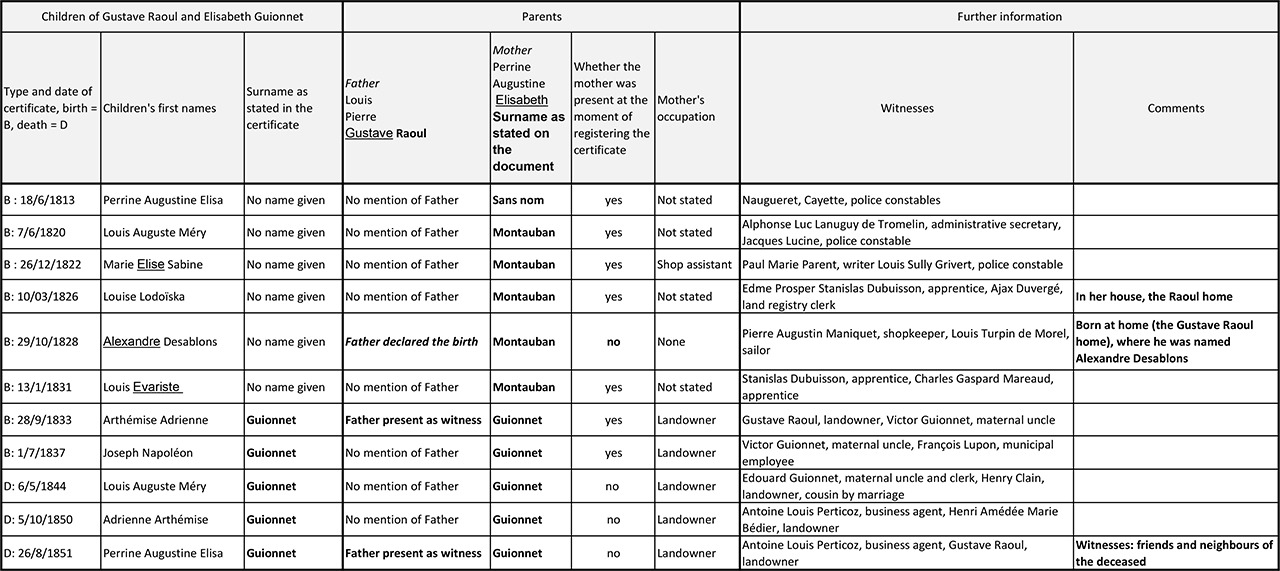
Whilst the two successive birth certificates from 1826 and 1828 give the impression of a normalisation (albeit an ambiguous one, given that the prohibitions remained in place) of the relationship between a man and a woman from different socio-ethnic groups, the other civil registry documents that follow show less latitude in the declarations given. Gustave Raoul is listed as a ‘witness / landowner’ for the birth of his daughter Arthémise Adrienne in 1833, and as a ‘witness / friend and neighbour’ at the death of his daughter Perrine Augustine Elisa in 1851.
This white man who had several children with a free woman of colour was willing to show his face, but did that mean he was prepared to acknowledge his offspring? It was not until 1852, following a notarised deed drawn up after the successive deaths of two daughters, that Gustave Raoul acknowledged the five remaining children. The entry was recorded in the civil registers in January 1856, a few months before the wedding of his daughter Élise Raoul to one of his neighbours, the business agent Antoine Louis Perticoz.
It is through the deeds of purchase or sale held in the land registry that it is possible to gather information enabling us to outline the extent of the property holdings of Elisabeth Guionnet and Gustave Raoul. Her income was derived from her successive professional activities (as already mentioned) and from the properties she received directly from her partner, Gustave Raoul. He mainly inherited the plot on the outskirts of Saint-Denis, which runs along the southern edge of the jardin du Roi, under a private deed drawn up to settle the division of the estate amongst his brothers and sisters in 1827. Her father, Louis Raoul, had acquired it from Monsieur Monique Léon in 1813. According to cross-references made with the current cadastral map of Saint-Denis (which provides a modern, standardised and geo-referenced view) and taking into account a layout that has changed little, the total area of the plots is exactly 7,606m². Including the western tip of Îlot Poivre (which is not attributed to any owner) the area is approximately 8,000 to 8,500 m². On three maps and plans drawn up in 1821, 1859 and 1861, the triangular plot is specifically identified by the surname ‘Raoul’. It is a large plot by Saint-Denis standards, situated on the outskirts of the town. Opposite lived one single neighbour, a Monsieur Bouls; further south, the ‘Camp des Noirs’ (slave camp) stretched out like a suburb prior to 1848; to the east lay the ‘Quartier des Libres de couleur’ (district for free people of colour). The main town’s social lay-out followed a strict colonial order: proximity when it came to human interactions, but their dwellings were kept at a distance.
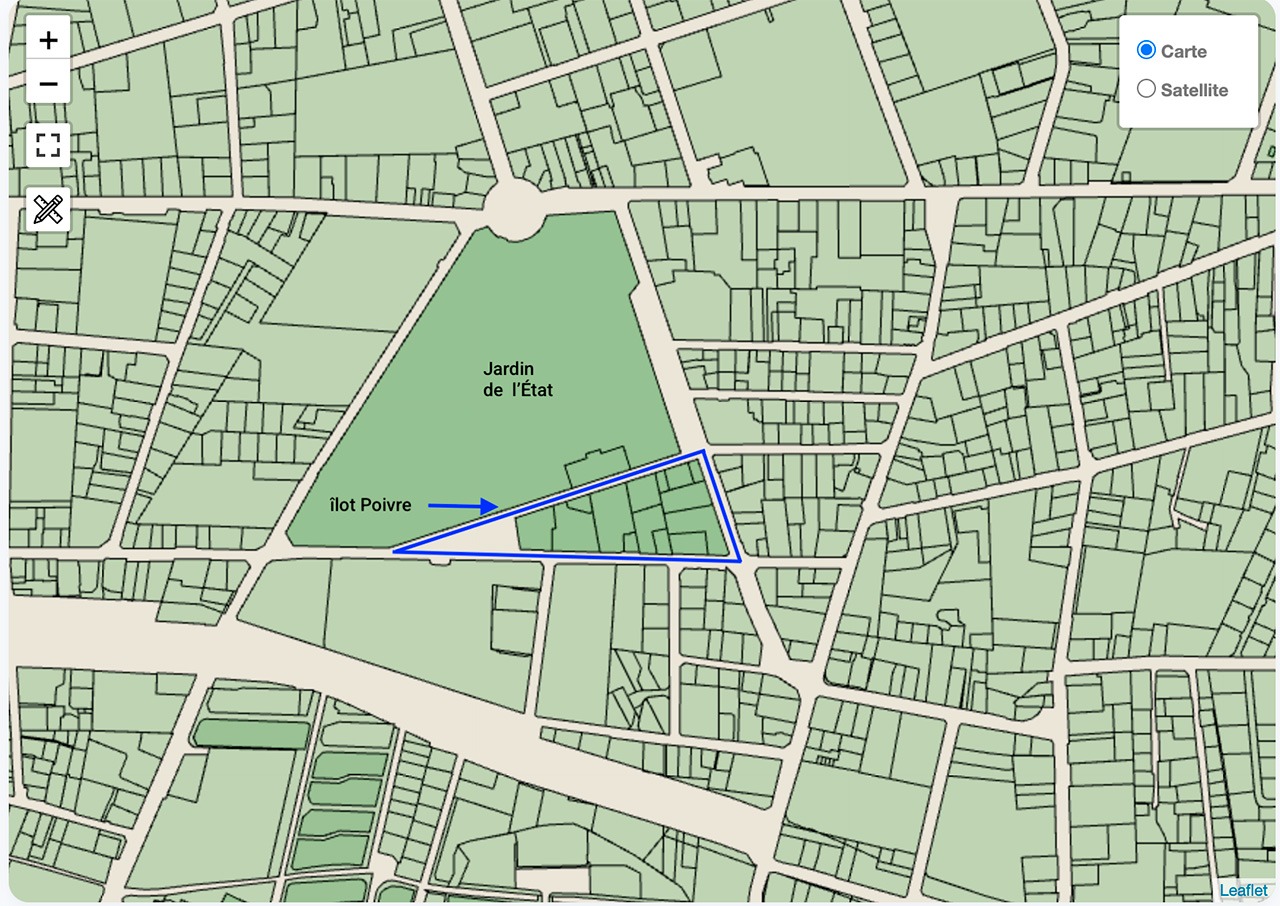
Gustave Raoul’s decision was presumably guided by reason. By retaining this ‘considerable’ plot (as it is described in most deeds) he was able, from 1830 onwards, to envisage selling it to Perrine Augustine Elisabeth Montauban with a view to transferring part of his land holdings to her, namely a plot of land, a house, outbuildings and a garden. The property also benefited from a water supply granted by the colony’s general administrators in 1816, a real luxury at the time! This deed, in which the seller had reserved the ‘right of usufruct’ for the duration of his life, was filed and transcribed verbatim just over a month after his death in the register of mortgage formalities. Was this a fictitious sale to protect the mother of his children? As the deed was drawn up with private signatures and filed posthumously, it is likely that Gustave Raoul received no payment whatsoever. Furthermore, certain transactions were drawn up before Maître Chasseriau, who was none other than Gustave Raoul’s first cousin.
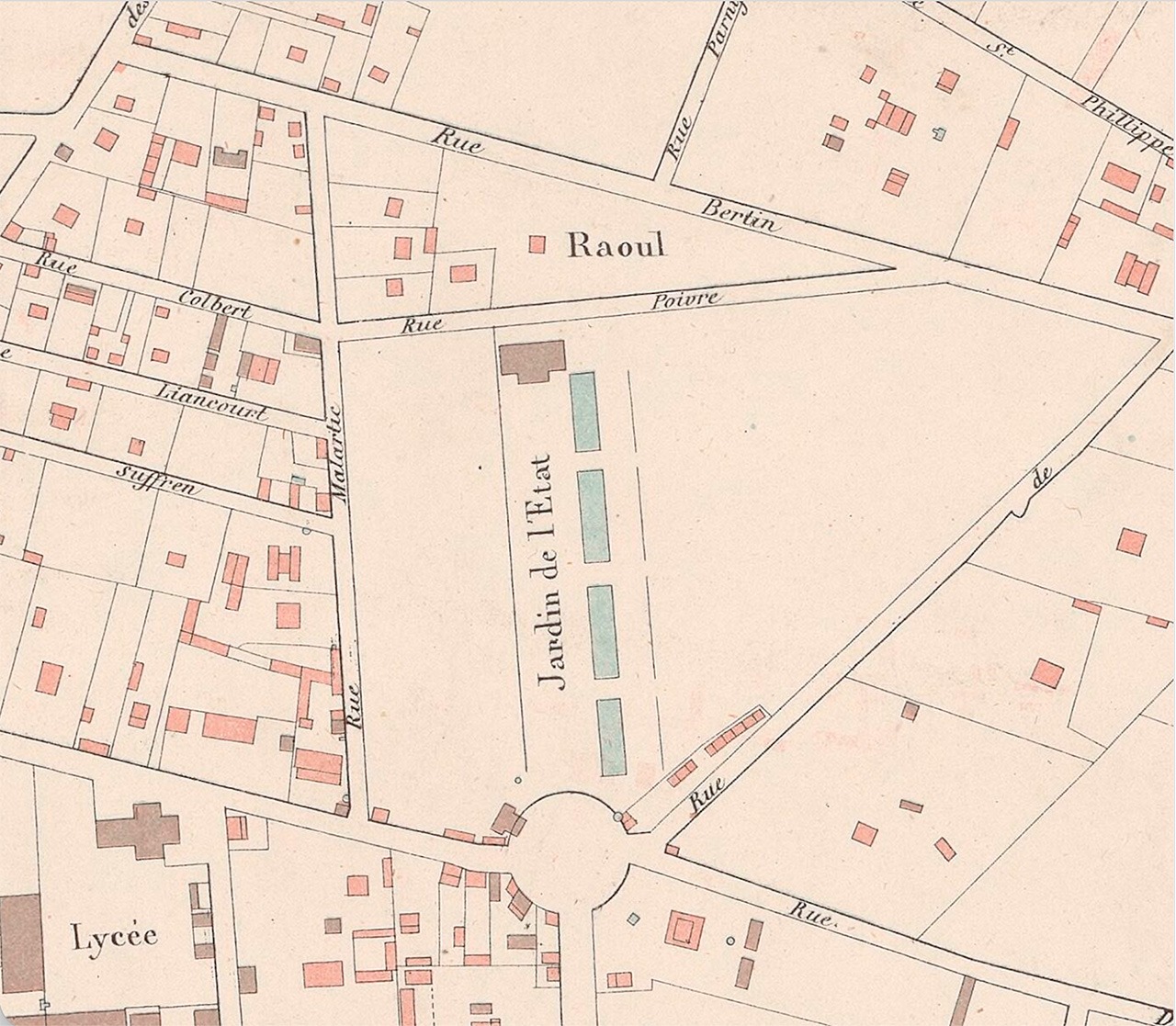
These various transactions gradually led to this plot of land being divided up, either due to practical considerations enabling an increasingly large household to provide for itself, or with the aim of creating a property for their children.
In this regard, Elisabeth Guionnet bequeathed a property portfolio to her daughters as they came of age, no doubt with a view to providing them with a set of assets for their future households. This age-old practice laid the material foundations for civil marriage by helping future couples to set up home. The three sisters soon left the family home and became seamstresses. Elisabeth sold an undeveloped plot to each of them: the eldest daughter, Elisa, became a property owner in 1846, whilst Élise, although younger, preceded her in 1845 by purchasing 775m². Finally, Lodoïska’s situation merits closer attention: she was an underage single mother to a boy named Léopold. For the boy, a whole matrilineal strategy was put in place to provide him with an inheritance. As the child was a minor, his great-grandmother, Fine Guionnet, acted as guarantor for the deed of sale drawn up by his grandmother, Elisabeth Guionnet, who transferred to him, for the sum of 3,226 francs, a plot of land measuring 710m2. Fine Guionnet paid ‘with funds belonging to the said minor, Léopold Guionnet, and received by him as a gift made during his lifetime’. Who was behind this transfer of hard cash to the great-grandmother? Was this another sham transaction? Be that as it may, two women, Elisabeth Guionnet and her mother Fine Guionnet, protected the fatherless child through their generosity.
Yet the Civil Code of 1804 enshrines women’s legal incapacity, whilst establishing the hierarchy of male authority within the nuclear family: a woman must be assisted by or have her husband’s authorisation to carry out many property-related acts on her own. Conversely, this is precisely Elisabeth Guionnet’s advantage: as an unmarried woman, her legal capacity was more extensive and equivalent to that of an adult man, enabling her to acquire, sell or donate property, to accept or renounce an inheritance, to enter into contracts and to take legal action in her own name. Similarly, the widow Fine Guionnet was free from her husband’s guardianship and managed her property freely.
This matrilineality, however, does not in itself mean that these women (all of whom, moreover, were born free and of colour) held any economic power. It referred above all to a system of mutual support in which arrangements were put in place by these women to provide financial protection for their descendants. In these socio-ethnic groups, children belonged to their mother’s lineage. Collective assets, land and certain social roles were thus retained within the maternal lineage, ensuring its continuity across generations.
Elisabeth Guionnet and Gustave Raoul had eight children. Louis Méry and Adrienne died young, aged 23 in 1844 and 17 in 1850 respectively. Alexandre died unmarried at the age of 49. None of the three are known to have been married or to have had any descendants.
For the other siblings, the systematic analysis of marriage and birth records (of the third generation) also makes it possible to establish comprehensive social genealogies, which situate individuals within their family, professional, geographical and community contexts. Genealogy thus becomes a tool of social history based on several characteristics: alliances, endogamy, mobility and family reconfigurations are examined across several generations.
| Ethnic group | Occupation | Marital status | Spouse’s identity | Spouse’s occupation | Spouse’s ethnic group | Children | |
| RAOUL and GUIONNET had the following children: | |||||||
| 1. Perrine Augustine (Louise) Élisa GUIONNET (1813–1851) | Mixed race, born free, of colour | Seamstress Landowner | Unmarried | Jean Hyppolite Marie DE QUIRIEC DUTRÉVOU | Landowner | White | 1 recognised illegitimate child |
| 2. Louis Auguste Méry GUIONNET (1820–1844) | Mixed race, born free, of colour | Clerk | Unmarried | No descendants | |||
| 3. Marie Élise Sabine RAOUL (1822–1885) | Mixed race, born free, of colour | Seamstress Landowner | Married under the regime of separate property | Antoine Louis PERTICOZ | Business agent | White | No descendants |
| 4. Louise Lodoïska RAOUL (1826–1887) | Mixed race, born free, of colour | Seamstress Landowner | Unmarried | Unknown | 2 illegitimate children (one of whom died in infancy) | ||
| 5. Alexandre Armand Desablons RAOUL (1822–1878) | Mixed race, born free, of colour | Police officer | Unmarried | No descendants | |||
| 6. Louis Évariste Laurestan RAOUL (1831–1892) | Mixed race | Landowner Business agent | Married | Hélène Aglaé DIGARD | Unemployed, widow of a shopkeeper | White | 4 children, 3 of whom were legitimised by marriage |
| 7. Arthémise Adrienne GUIONNET (1833–1850) | Mixed race | No occupation | |||||
| 8. Joseph Napoléon RAOUL (1837–1890) | Mixed race | Stonemason | Married | Marie Alina SILAHOS | Seamstress | Mixed race | 5 children (including 2 who died in infancy) |
The ages at marriage were broadly the same for Évariste Raoul and Aglaé Digard, aged 29 and 30 respectively, as well as for Napoléon Raoul and Alina Silahos, aged 23 and 21 respectively. The age gap was greater between the Perticoz and Raoul couples: in this case, it was the first husband’s second marriage; he remarried in 1856 at the age of almost 58 to Miss Raoul, who was only 33. The eldest daughter, Elisa Guionnet, found herself in an unusual situation: in 1847, at the age of 34, she had a daughter with a young heir – Jean Hyppolite Marie de Quiriec (Kerriec) du Trévou, who was 16 years her junior! It is quite rare to find such an age gap between a woman and a man in civil registry records. Should this be seen as an ‘accident’ of their cohabitation, given that this was the only child they had together?
Neighbourly relations also encouraged socialising and marriages: Elise Raoul married her father’s neighbour, Antoine Louis Perticoz; Évariste Raoul became engaged to the widow Hélène Didominico (née Digard), to whom his mother had sold an undeveloped plot of land in 1850 ‘behind the jardin de la République’. There was clearly a sense of territoriality that influenced marital choices.
Like many Réunionese families of the nineteenth century, kinship was not entirely absent from marital choices: in his first marriage, Antoine Louis Perticoz married Gustave Raoul’s first cousin, Isoline Rathier Duvergé; he then married a relative of his first wife, Elise Raoul. Elise Raoul is, in fact, the only child among the descendants of Elisabeth Guionnet and Gustave Raoul to have drawn up a marriage contract with Antoine Louis Perticoz. She is undoubtedly the most independent of the daughters; it is she who signed numerous official documents. Élise Raoul was subject to the regime of separate property; she was not liable for her husband’s debts and had full control over her own property and affairs. Her personal effects, linen and jewellery amounted to the tidy sum of 16,345 francs; her receivables and cash totalled 1,655 francs; and finally, a plot of land acquired from her mother, the value of which was not assessed, completed the dowry.
Whilst geographical endogamy is a key factor in the marital situations of all the Raoul-Guionnet children, the situation is quite different when it comes to ethnic group affiliation: with the exception of Napoléon Raoul, who married Alina Silahos in 1863 (of Malay origin through her mother, Alida Silahos) and who, like her, had mixed ethnic origins, the other siblings all married white partners. However, this strategy of exogamous marriage did not always endure. The birth of a daughter from the relationship between Élisa Guionnet and Jean Marie Hyppolite de Quiriec, son of the Count of Trévou, never led to a union between the two. The father did not acknowledge his only child (Marie Mathilde) until 1862, more than ten years after her mother’s death. Marie Mathilde du Trévou married Albert Hubert-Delisle in 1867, yet she did not forget her maternal family, as she later took in her two aunts, the widow Élise Perticoz and Lodoïska Raoul, in their twilight years.
Various archival sources shed light on the individual life story of Élisabeth Guionnet, set against the backdrop of a society deeply marked by ethnic and social hierarchies.
Her cohabitation and her late marriage to Gustave Raoul illustrate the complex relationships that could develop beyond the social and legal barriers that governed such relationships. Moving into a home situated behind the colonial garden shows just how physical spaces could reflect power relations and the forms of proximity or separation between different groups within colonial society.
Finally, an examination of the social circumstances of the children of Élisabeth Guionnet and Gustave Raoul reveals that the family’s history became part of a new dynamic, which emerged largely following the abolition of slavery. Their descendants followed varied paths through life, marked by opportunities for social advancement, but also by the persistence of categories and perceptions inherited from colonial society.
The writing of this essay, the insights presented in which form a necessary prerequisite for a more in-depth study, offers a glimpse into a broader reality: that of individuals and families who, despite the constraints linked to their skin colour and origins, developed strategies to improve their circumstances and pass on a certain amount of social capital to subsequent generations.


Domaine Panon-Desbassyns
Saint-Gilles-Les-Hauts
Tel. : 0262 55 64 10
Email: musee.villele@cg974.fr
Get there
Open from Tuesdays to Sundays 9.30am to 12.30pm and 1.30pm to 5.30pm
Closed on Mondays
Closed 1st May / 1st January / 25th December
Scientific committee
Legal notice