In an era when nothing was automated, servants were indispensable to any wealthy family. It took many hands and a great deal of time to carry out the daily tasks necessary for the smooth running of a household. This domestic staff, working under the authority of their masters, functioned like a small, highly hierarchical business, with its managers, assistant managers, specialists and workers.
The educational treatises on relations between masters and their domestic slaves, which proliferated throughout the 18th century, often echoed the famous Maison Rustique, a hugely influential model in the Indian Ocean. This treatise established the spatial and social organisation of a rural dwelling built around the master’s home. The master would organise the different areas and agricultural or domestic workers, roles taken over by slaves in the colonies.
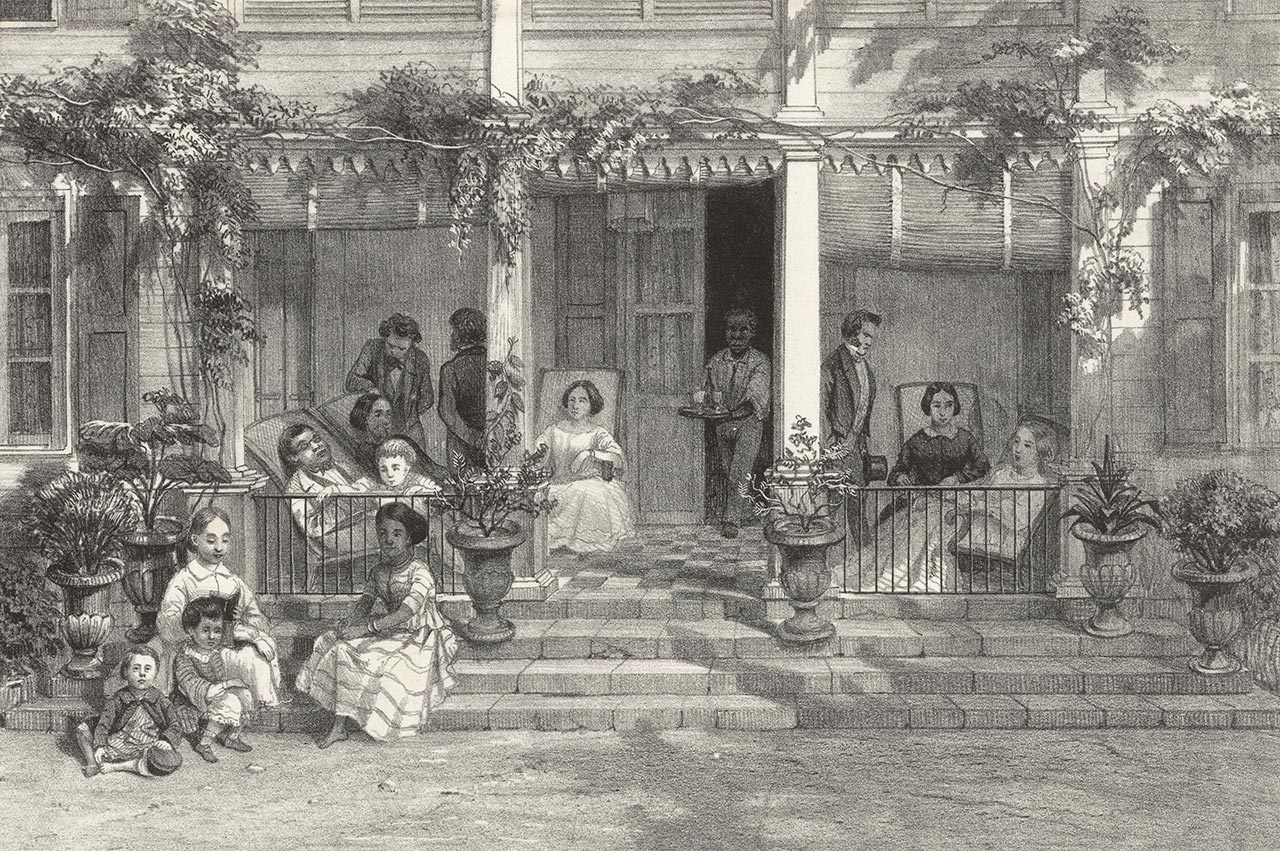
From the second half of the 18th century onwards, many paintings depicted narrative scenes featuring anonymous, zealous servants captured in the throes of their gruelling tasks.
When compared with other colonial contexts, images depicting slaves at work in the Mascarene Islands remain few in number. However, a number of significant examples do exist, such as scenes depicted by Jean-Joseph Patu de Rosemont in Île Bourbon in the early 19th century, or those featured in Jacques-Gérard Milbert’s Album Île de France during the same period. Figures portrayed by Jean-Baptiste Dumas in the first third of the 19th century complete these representations of slaves, who remain forever anonymous.
For an art historian, drawing on iconography from other regions serves to enrich the narrative, provided one focuses on similar contexts that are close to the references of the period. These images also demonstrate that these slaves were not necessarily invisible. The substantial body of thematic images relating to the Caribbean, Brazil, Mexico, Peru, Indonesia, India and the early states of North America bears witness to a historical reality that merits closer examination in order to better define, by comparison, the servile domesticity of the Mascarene Islands.
Domaine Panon-Desbassyns
Saint-Gilles-Les-Hauts
Tel. : 0262 55 64 10
Email: musee.villele@cg974.fr
Get there
Open from Tuesdays to Sundays 9.30am to 12.30pm and 1.30pm to 5.30pm
Closed on Mondays
Closed 1st May / 1st January / 25th December
Scientific committee
Legal notice